Two orders, one game
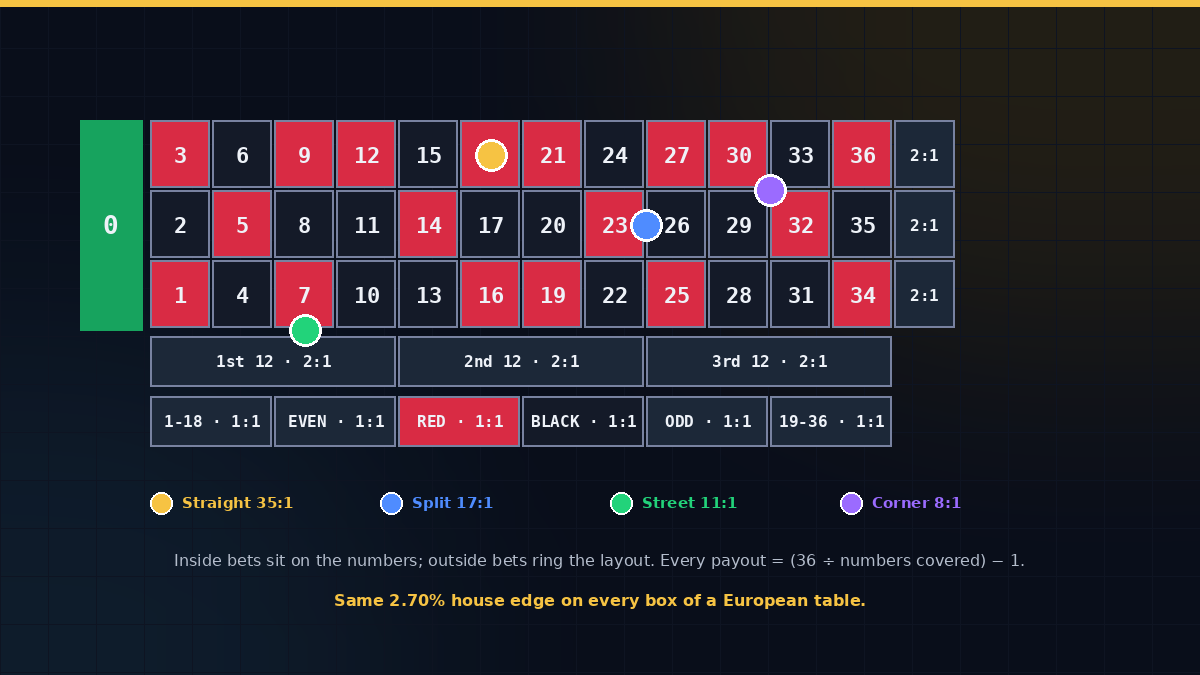
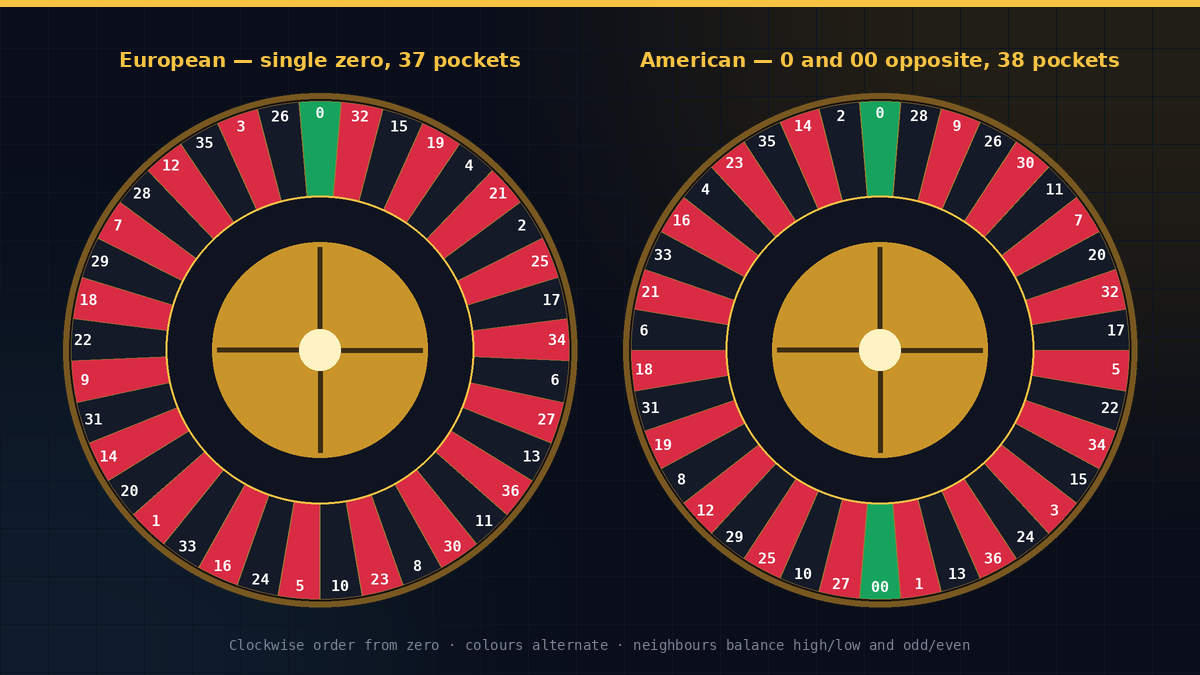
The numbers on a roulette wheel are not in numerical order, and the layout on the table — three columns of twelve in sequence — bears no resemblance to the rim. The wheel order was designed in the nineteenth century to spread colours, odd and even numbers and high and low numbers as evenly around the circle as possible, so that no sector of the wheel favours any outside bet. Both the European and American wheels achieve that, in different ways.
The European sequence
Clockwise from the single zero: 0, 32, 15, 19, 4, 21, 2, 25, 17, 34, 6, 27, 13, 36, 11, 30, 8, 23, 10, 5, 24, 16, 33, 1, 20, 14, 31, 9, 22, 18, 29, 7, 28, 12, 35, 3, 26. Colours alternate strictly. Pairs of adjacent numbers tend to sum to 37 (32+5, 15+22, 19+18…) on opposite sides of the wheel, which is how high and low were balanced. Every demo wheel on this site except Mini and American uses exactly this order; you can check it against the European demo by stepping around the rim.
The American sequence
Clockwise from 0: 0, 28, 9, 26, 30, 11, 7, 20, 32, 17, 5, 22, 34, 15, 3, 24, 36, 13, 1, 00, 27, 10, 25, 29, 12, 8, 19, 31, 18, 6, 21, 33, 16, 4, 23, 35, 14, 2. The two zeros sit opposite each other; consecutive numbers (1 and 2, 3 and 4…) sit directly across the wheel. The American order is less celebrated than the European one because the wheel's other feature — the extra pocket — matters far more than any elegance in the sequence. See the American demo.
Sectors and the racetrack
Because the rim order is fixed, bets on physical sectors of the wheel became standard on French tables, placed on an oval "racetrack" beside the main layout. Voisins du zéro covers the 17 numbers from 22 to 25 around zero with nine chips. Tiers du cylindre covers the 12 numbers opposite, from 27 to 33, with six chips on splits. Orphelins covers the eight numbers left over with five chips. Jeu zéro is a smaller seven-number bet hugging zero. Every one of these is a bundle of ordinary splits and straight bets at the ordinary 2.70% edge; the racetrack is a convenience, not a different game.
Neighbour bets
A neighbour bet is a straight-up bet on a number plus the two (or more) pockets either side of it on the rim — five chips, five numbers, 35:1 on whichever hits. Players use them when they believe a dealer's release is consistent enough to land the ball in a predictable sector. On a physical wheel with a human dealer that belief is at least testable; on an RNG wheel it is meaningless, because there is no ball track, only a random draw. Online racetracks exist because players expect them.
Does the order matter?
For the odds, no. Every pocket on an RNG wheel is equally likely regardless of its neighbours, and the sector bets cost the same as any other combination of the same numbers. For a physical wheel, slightly: a biased or worn wheel favours a sector, and the order tells you which numbers that sector contains. Detecting a bias takes thousands of recorded spins on one specific wheel, which is why the famous cases — Jaggers at Monte Carlo in 1873, the Garcia-Pelayo family in the 1990s — involved teams, weeks of clocking, and wheels that were promptly replaced. For everyone else the order is a piece of history worth knowing and nothing more.