Joseph Jagger, Monte Carlo, 1873
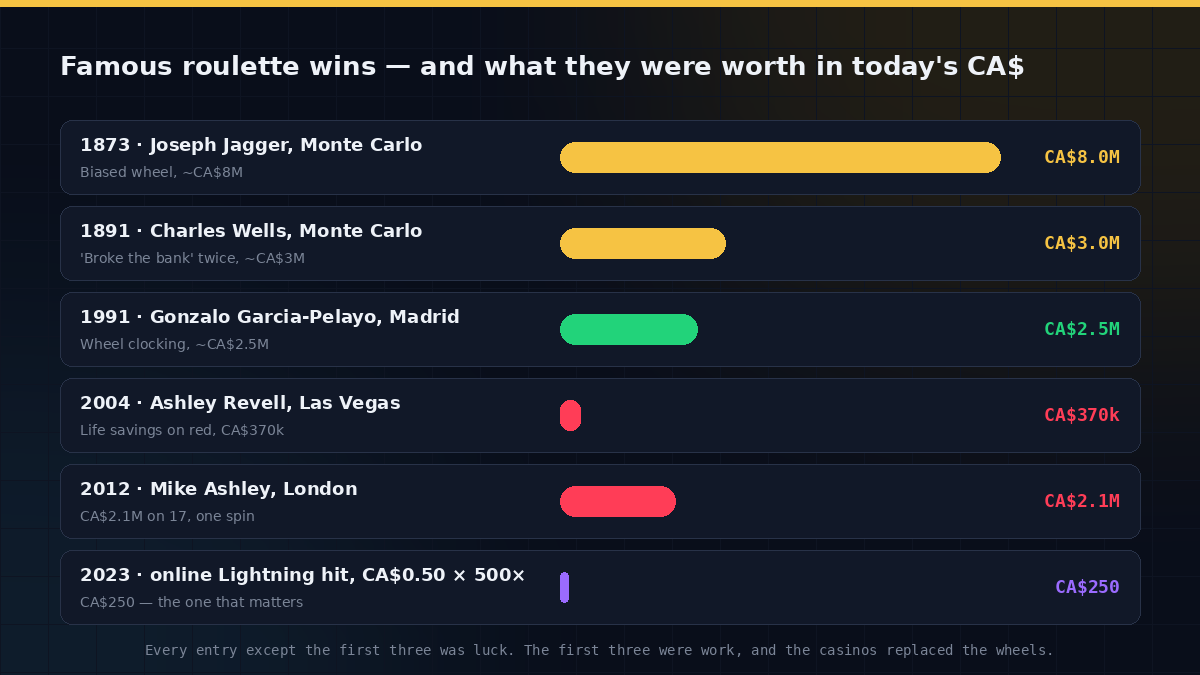
Jagger was a Yorkshire textile engineer who understood that a machined wheel could be imperfect. He hired six clerks to record every result on the Beaux-Arts casino's wheels for a week, found one wheel on which nine numbers hit far more often than 1 in 37, and bet them. Over several days he won around 2 million francs — roughly CA$8 million today — before the casino swapped the wheels around and, later, introduced movable frets so pockets could be reconfigured nightly. Jagger left with most of the money and bought property in Bradford. His win was engineering, not luck, and it is the reason modern wheels are inspected, rotated and replaced on a schedule.
Charles Wells, 1891
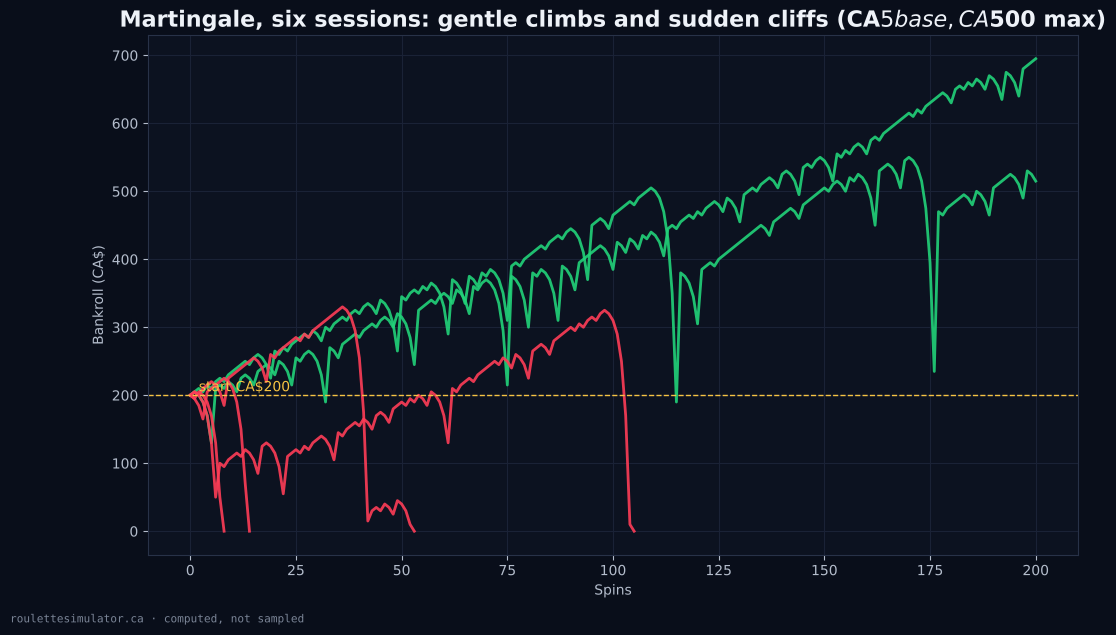
Wells "broke the bank" at Monte Carlo — that is, emptied the 100,000-franc reserve at a table — several times across two visits, winning about a million francs (CA$3 million today). He claimed a system; it was almost certainly variance, and his later life (prison for fraud in two countries) suggests he knew it. The song "The Man Who Broke the Bank at Monte Carlo" made him famous. His money was gone within a few years.
The Garcia-Pelayo family, 1990s
Gonzalo Garcia-Pelayo, a Spanish record producer, did what Jagger did with a computer. His family recorded tens of thousands of spins at Casino de Madrid, identified wheels with measurable bias, and won around CA$2.5 million in Spain and later in Las Vegas. The casino sued; the Spanish Supreme Court ruled that observing a public wheel is not cheating. Casinos responded with better wheels and shorter rotation cycles. It remains the last well-documented bias win — the equipment has been too good since.
Ashley Revell, Las Vegas, 2004
Revell sold everything he owned — house, car, clothes — for £76,840, flew to the Plaza in Las Vegas, and put it all on red. The ball landed on red 7. He doubled to about CA$370,000, tipped the dealer, and went home. It is the purest single roulette bet on record: 48.65% to double, 51.35% to lose everything, no system, no skill, and no second attempt.
Mike Ashley, London, 2012
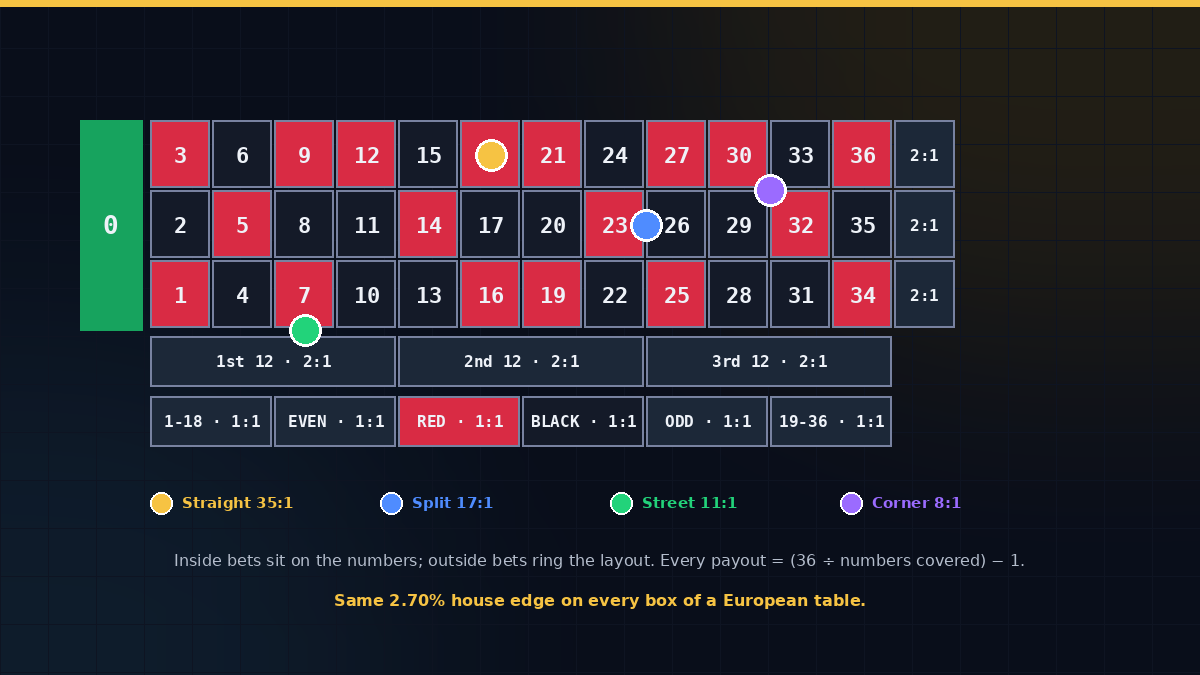
The Newcastle United owner walked into a Mayfair casino, placed a "complete" bet on 17 — straight, splits, streets, corners, line — totalling £480,000, and watched 17 come in. He collected £1.3 million (about CA$2.1 million) in under five minutes. The complete bet pays every inside combination containing 17 at once; the probability of the number was still 1 in 37.
What the big wins have in common
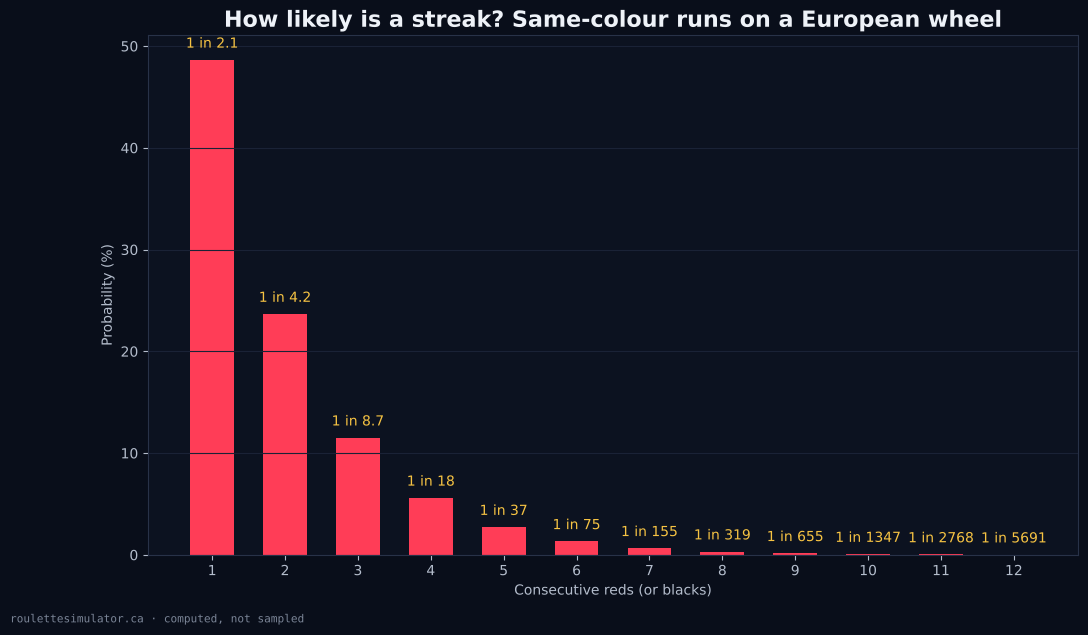
Three were work on broken equipment, two were coin-flips with large coins. None involved a betting system, a lucky number, or a streak. The arithmetic Ravi lays out in the odds guide applied to every one of them, and every one of them has a counterpart who lost the same way and did not get a newspaper story. If you want to feel what Revell felt, the free European wheel will give you the 48.65% with demo money.
Big wins online: Lightning multipliers
For a Canadian playing online, the realistic "big win" is a Lightning Roulette multiplier: a CA$1 straight bet on a struck number at 500× returns CA$500. Our Lightning demo reproduces the multiplier distribution; the hit rate on any one number is still 1 in 37, and the straight-bet edge is 2.99%. Casinos in our bonus table — Rainbet, Stake and Roobet in particular — run the live version.