The claim every system makes
Every roulette betting system is a rule for changing the bet size based on previous results. Every one of them is sold on the same implicit claim: that by sizing bets cleverly you can win more when you win than you lose when you lose. The arithmetic says otherwise. Each bet has an expected value of −2.70% of its size on a European wheel. The sum of negative numbers is negative. No ordering of bet sizes changes the sign, only the shape of the distribution. Ravi built the strategy simulator so you can watch each shape for yourself rather than take that on authority.
Martingale
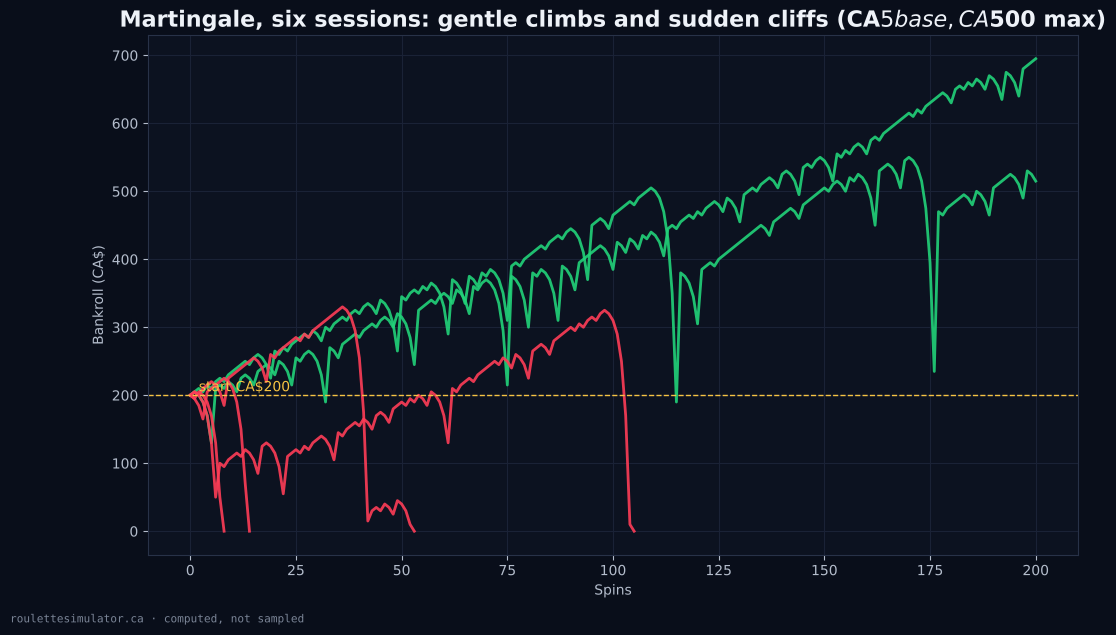
Double after every loss, return to the base bet after a win. Each winning spin recovers all previous losses plus one base unit. On paper it cannot lose. In practice it needs an infinite bankroll and no table maximum, and casinos provide neither. Six losses in a row (probability 1.5% per sequence on an even-money bet) turn a CA$5 bet into CA$320 on the seventh spin; nine losses need CA$2,560. The simulator's Martingale curve is a gentle staircase up, then a cliff. Run it twenty times at 200 spins with a CA$200 bankroll and a CA$500 maximum: most runs end slightly ahead, a few end with nothing, and the sum is about what the house edge predicts.
Fibonacci and D'Alembert
Fibonacci moves up one step in the sequence 1, 1, 2, 3, 5, 8, 13… after a loss and back two steps after a win. D'Alembert adds one unit after a loss and removes one after a win. Both are Martingales with the volume turned down: slower to climb, slower to recover, and with the same fatal flaw that a long losing run demands bets the bankroll cannot cover. D'Alembert's appeal is the idea that wins and losses "balance" — which is true in the long run for a fair coin and false for a wheel with a zero.
Labouchère
Write a list of numbers, say 1-2-3-4. Bet the sum of the first and last (5 units). Win: cross both off. Lose: add the lost amount to the end. The session ends when the list is empty, with a profit equal to the original sum. It feels like bookkeeping rather than gambling, and the simulator shows why that is an illusion: after a losing streak the list grows long and the bets at its ends grow large, exactly like a Martingale sequence written sideways.
Paroli and positive progressions
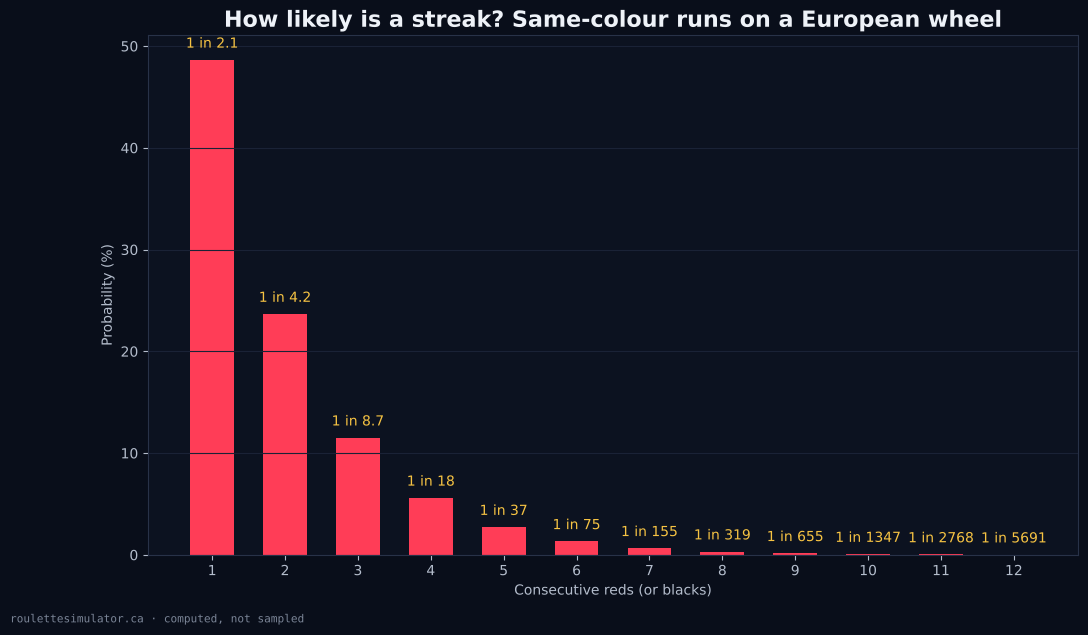
Paroli doubles after a win, up to three wins, then resets. Since you are only ever increasing bets with money just won, the downside per sequence is one base unit. The upside is seven units on a three-win streak (probability 11.5% on a European even-money bet). Positive progressions do not risk ruin the way Martingale does; they simply rearrange a flat bet's outcomes into more small losses and fewer large wins. The expected value is identical.
Flat betting and what actually helps
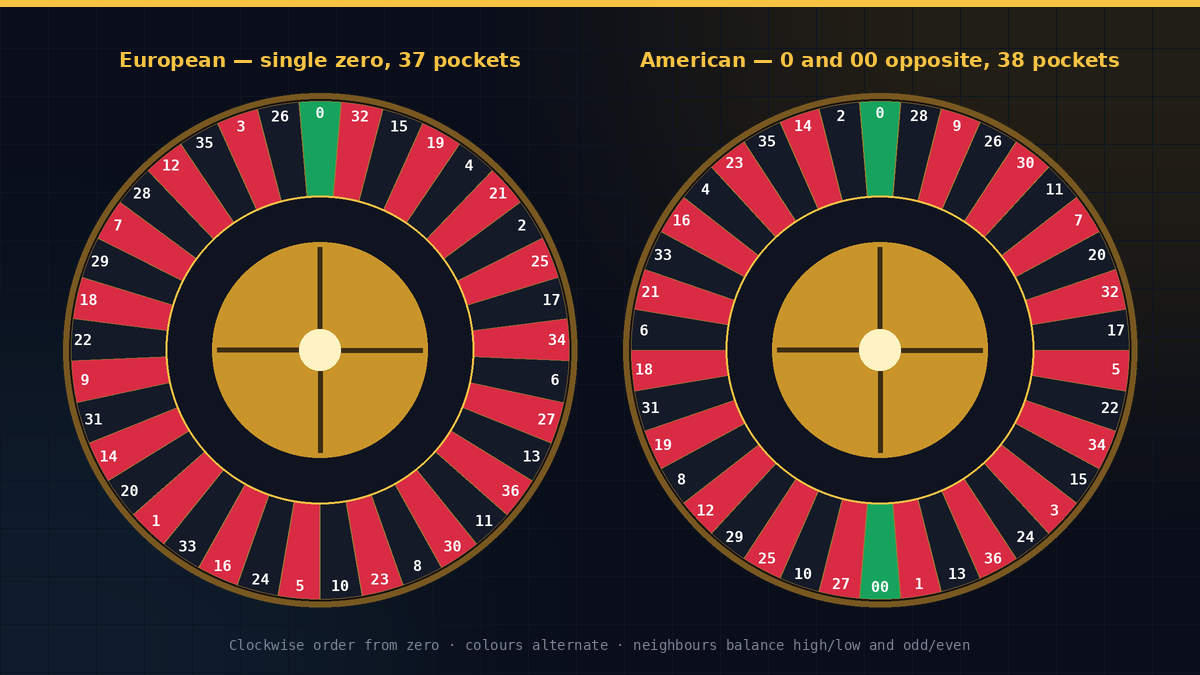
Flat betting — the same stake every spin — is not a system, which is its merit. It gives the smallest variance for a given stake and makes the cost of play exactly predictable: edge × stake × spins. If you want to reduce that cost there are only three levers, and the simulator demonstrates each. Pick the wheel with the lowest edge (French at 1.35% on even-money bets). Reduce the stake. Play fewer spins per hour (a live table at 40 spins costs half what an RNG table at 80 does). Rakeback at Thrill, Stake or Duel is a fourth lever: a cash rebate on the edge itself. None of these is exciting. All of them work, which is more than can be said for the systems above.