How a round of roulette works
A round has three phases. Betting opens and players place chips on the layout — the grid of 36 numbers plus zero and the outside boxes around it. The dealer (or the software) spins the wheel one way and launches the ball the other; betting usually stays open for the first few seconds of the spin, until "no more bets". The ball drops into a pocket, the dealer marks the winning number with a dolly, sweeps the losing chips, and pays the winners. Online, the whole cycle takes 30 to 60 seconds on an RNG table and 60 to 90 on a live one.
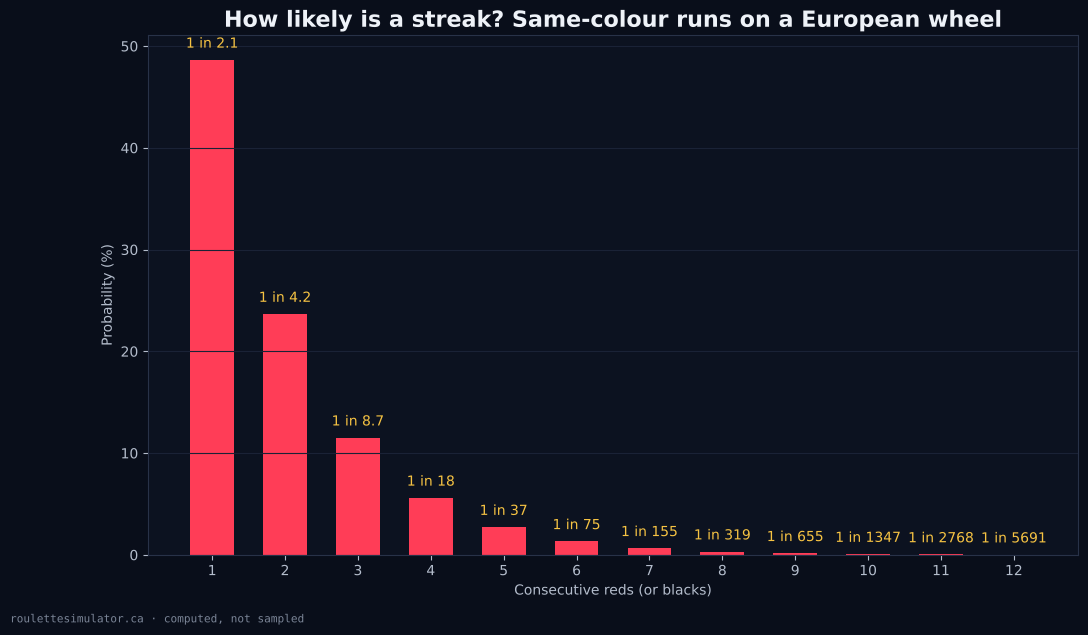
Everything else in roulette is a detail of where you may put chips and what the house pays when the ball agrees with you. There are no decisions after the bet is placed, no skill element, and no information from past spins that changes the next one.
Inside bets
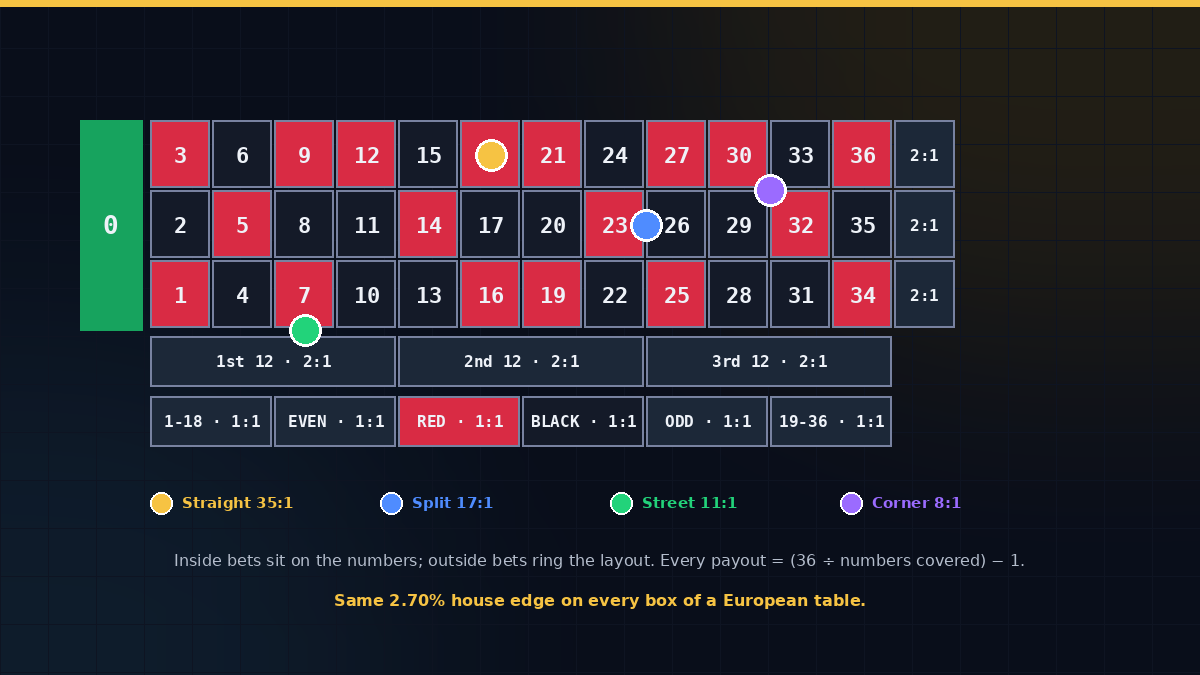
Inside bets sit on the numbers themselves. A straight-up bet covers one number and pays 35:1. A split covers two adjacent numbers (chip on the line between them) and pays 17:1. A street covers a row of three (chip on the row's outer edge), 11:1. A corner covers four numbers meeting at a point, 8:1. A six-line covers two adjacent rows, 5:1. On American tables only there is the five-number bet on 0, 00, 1, 2 and 3 at 6:1 — the one bet on any layout with a worse edge than its neighbours.
The payouts follow one formula: (36 ÷ numbers covered) − 1. That is the clue to the whole game. The formula assumes 36 pockets; the wheel has 37 or 38.
Outside bets
Outside bets cover groups of twelve or eighteen numbers. Dozens (1–12, 13–24, 25–36) and columns (each vertical line of twelve on the layout) pay 2:1. Red or black, odd or even, and low (1–18) or high (19–36) pay 1:1. Zero is neither red nor black, odd nor even, low nor high, so every outside bet loses when zero hits — unless the table plays la partage or en prison, covered below.
A useful way to see the layout: inside bets are expensive lottery tickets with the same long-run price as outside bets. CA$10 on red loses CA$0.27 per spin on average; CA$10 on 17 loses CA$0.27 per spin on average. One is a coin-flip with a 1.35% fee each way; the other is a 1-in-37 shot. Choose by the ride you want, not the price.
The three main tables
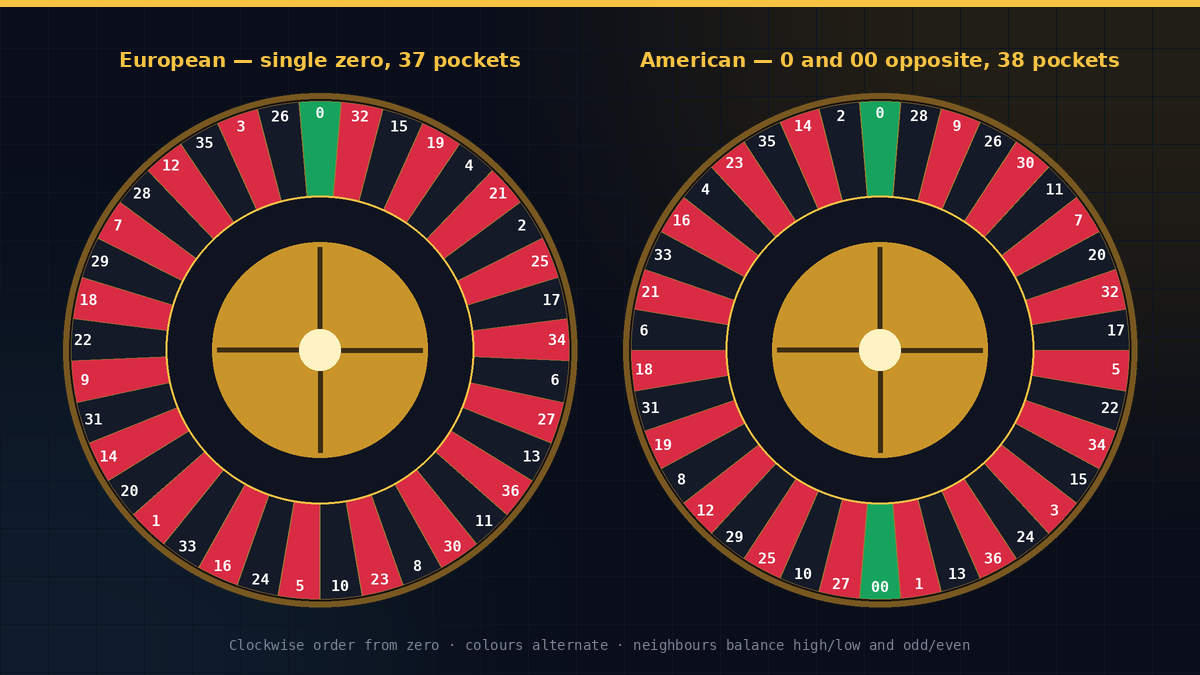
European: 37 pockets, single zero, 2.70% edge on every bet. The default online. American: 38 pockets with 0 and 00, 5.26% edge, standard at Canadian land-based casinos. French: the European wheel plus la partage, which returns half of even-money bets when zero hits, cutting their edge to 1.35%. Some French tables use en prison instead: the even-money bet is held for the next spin and returned in full if it then wins. Same edge, different mechanism. Our six demo wheels let you play all three plus Lightning, Mini and Double Ball.
Rules that only exist online
RNG roulette adds a few things a physical table cannot. Racetrack betting (voisins du zéro, tiers du cylindre, orphelins, neighbours) is a click away rather than a called bet. Auto-play spins repeatedly with the same bets. Turbo mode cuts the animation. Most sites impose a maximum bet while a bonus is active — typically CA$5 to CA$7 — and count roulette at a reduced rate toward wagering, which matters more than any rule on the felt; see the wagering calculator.
Live-dealer etiquette
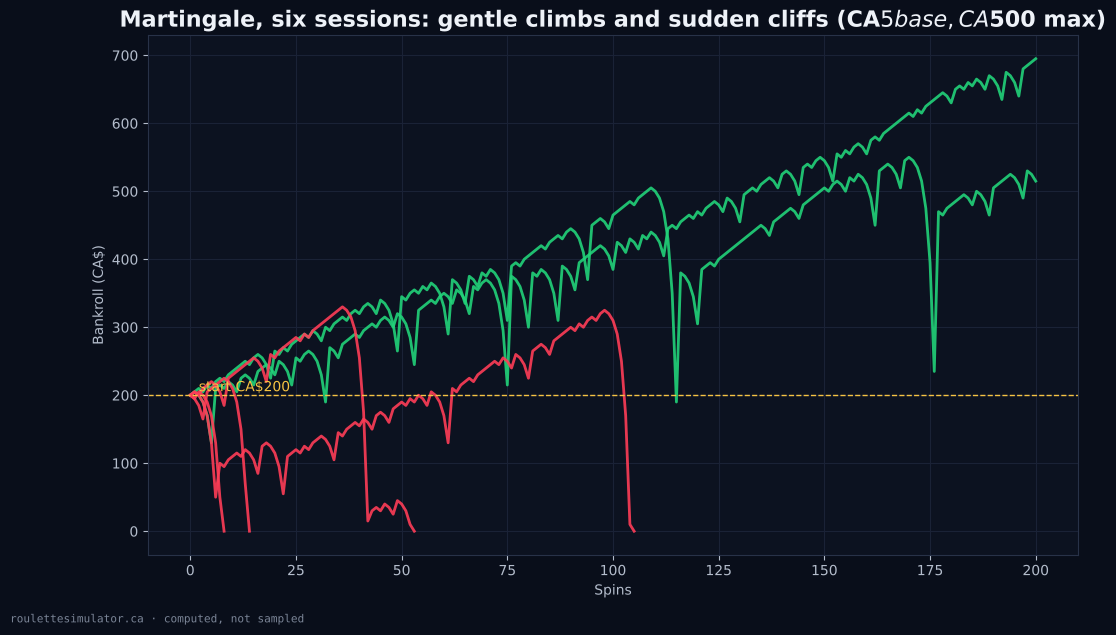
Live tables stream a human dealer from a studio, and the social rules are simplified: there is a chat box, tipping is a button, and you cannot touch another player's chips because there are none. Two habits from the floor still help. Place your bets early rather than in the last second before "no more bets" — late bets are sometimes rejected and you will not know until the ball drops. And do not chase. The dealer at Charlevoix who taught Étienne had a line for players doubling after a loss: "The wheel does not know you are behind."