Probability of a single bet
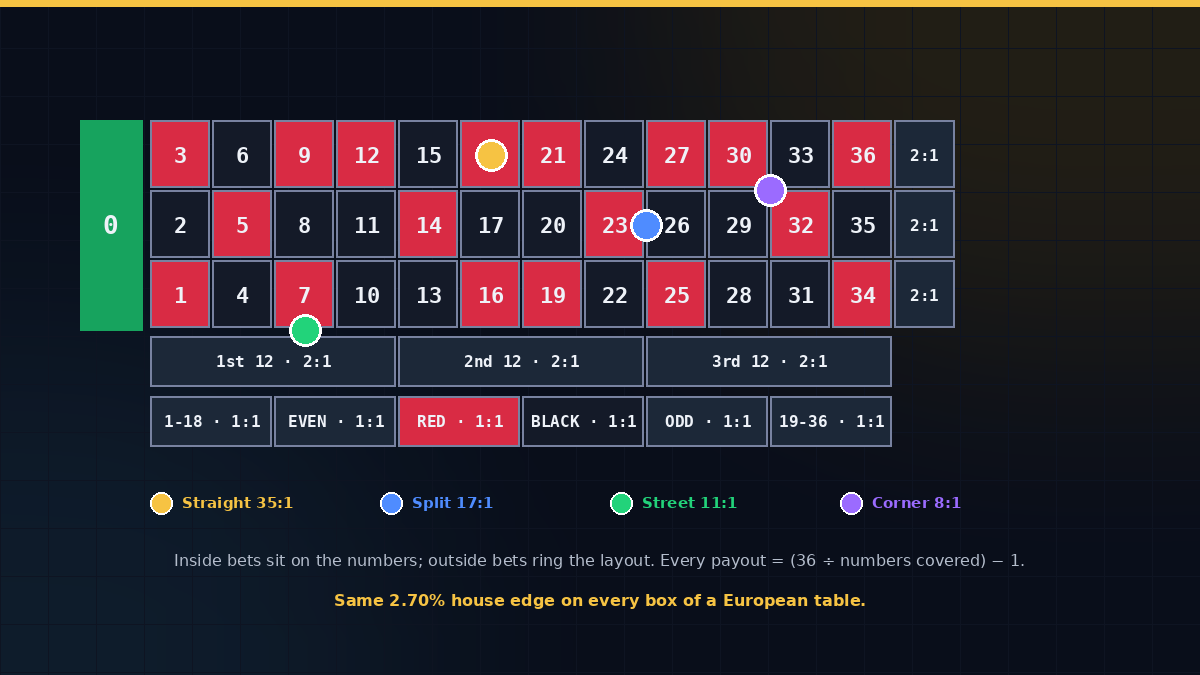
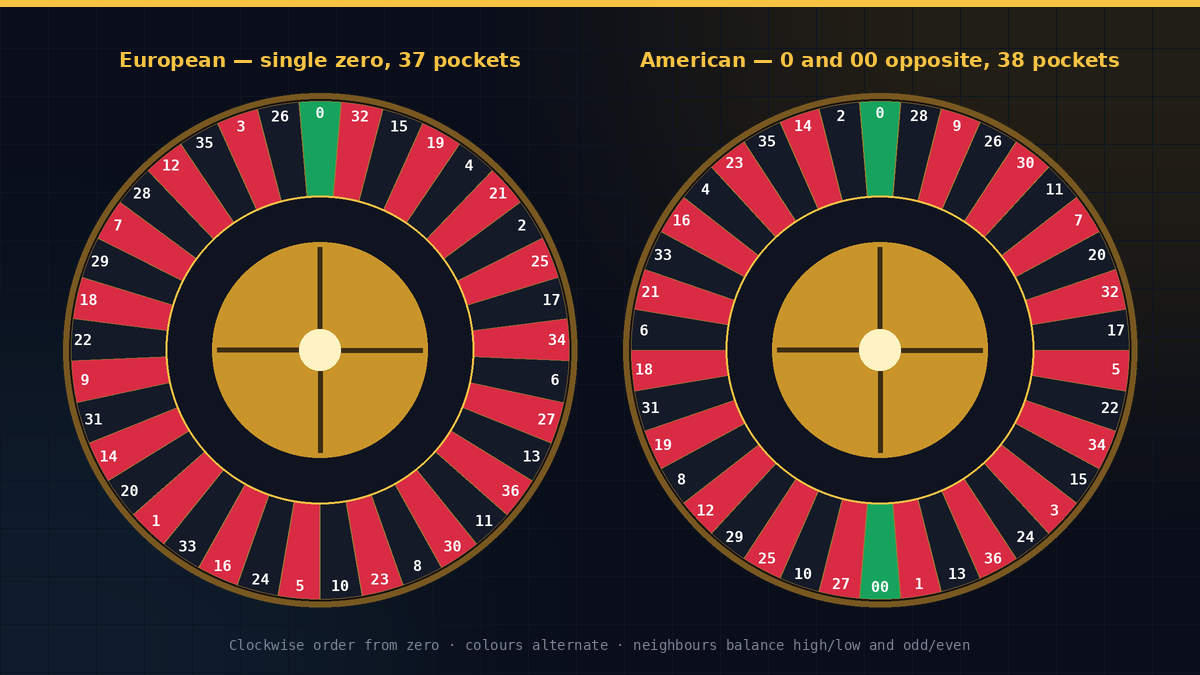
A roulette wheel is a uniform random draw from n pockets: 37 on a European wheel, 38 on American, 13 on mini. The probability that a bet wins is the number of pockets it covers divided by n. Straight-up on European: 1/37 = 2.703%. Red: 18/37 = 48.65%. A dozen: 12/37 = 32.43%. The odds against, which is how payouts are quoted, are (n − covered) : covered — 36:1 against a straight-up bet.
Where the house edge comes from
The casino pays 35:1 on a bet whose true odds are 36:1. Bet CA$1 on every number across 37 spins and in an average cycle each number hits once: you stake CA$37, win once, and receive CA$36 (35 profit plus 1 stake). You are down CA$1 on CA$37 wagered: 1/37 = 2.70%. The same calculation on a 38-pocket wheel gives 2/38 = 5.26%. On mini roulette with 11:1 payouts and 13 pockets, 1/13 = 7.69%.
Expected value per CA$1 bet is therefore (p × payout) − (1 − p) × 1. For red on European: (18/37 × 1) − (19/37 × 1) = −1/37 = −2.70%. For la partage on the same bet: (18/37 × 1) − (18/37 × 1) − (1/37 × 0.5) = −1/74 = −1.35%. The odds calculator does this for any bet and stake.
Why every bet has the same edge
Because the payout formula (36 ÷ covered) − 1 is used for every inside bet and the outside bets are priced consistently with it, every bet on a given wheel returns 36/37 of stake in the long run. The exception is the American five-number bet: 5 pockets paying 6:1 returns 35/38, an edge of 7.89%. It survives on layouts only because few players compute it.
Streaks, clusters and the gambler's fallacy
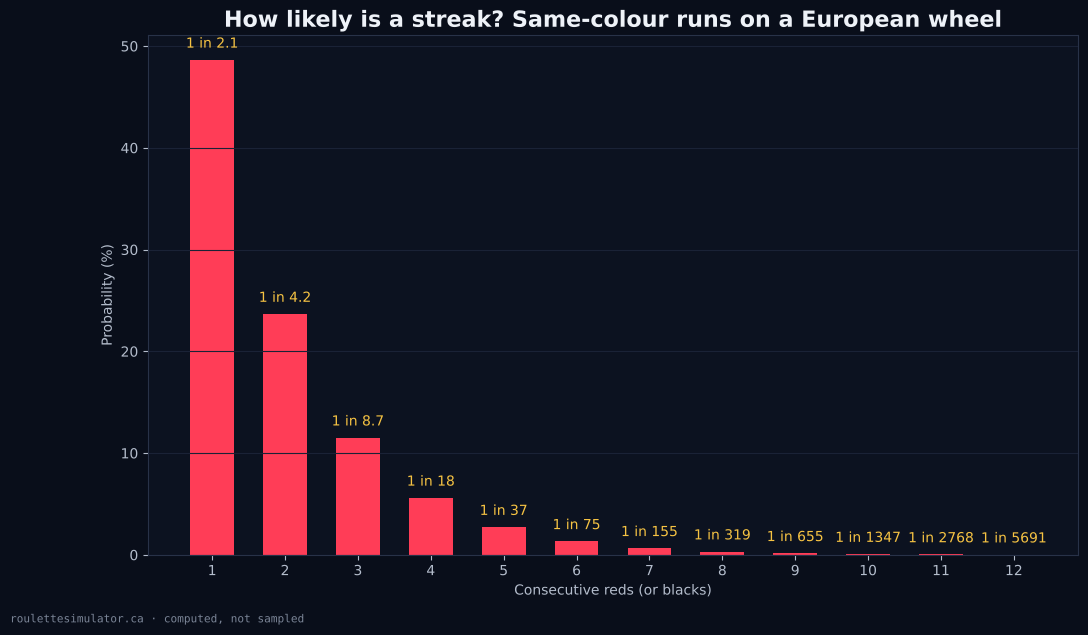
Each spin is independent; the wheel has no memory. After ten reds the probability of red on the next spin is still 18/37. The gambler's fallacy is the belief that black is now "due". Its mirror, the hot-hand fallacy, is the belief that red is "running". Both are refuted by the same observation: the ball does not know what happened. The wheel simulator will show you that ten reds in a row occurs about once every 1,400 spins on a European wheel — rare enough to feel meaningful, common enough to see every week on a busy table.
Variance: the number that actually hurts
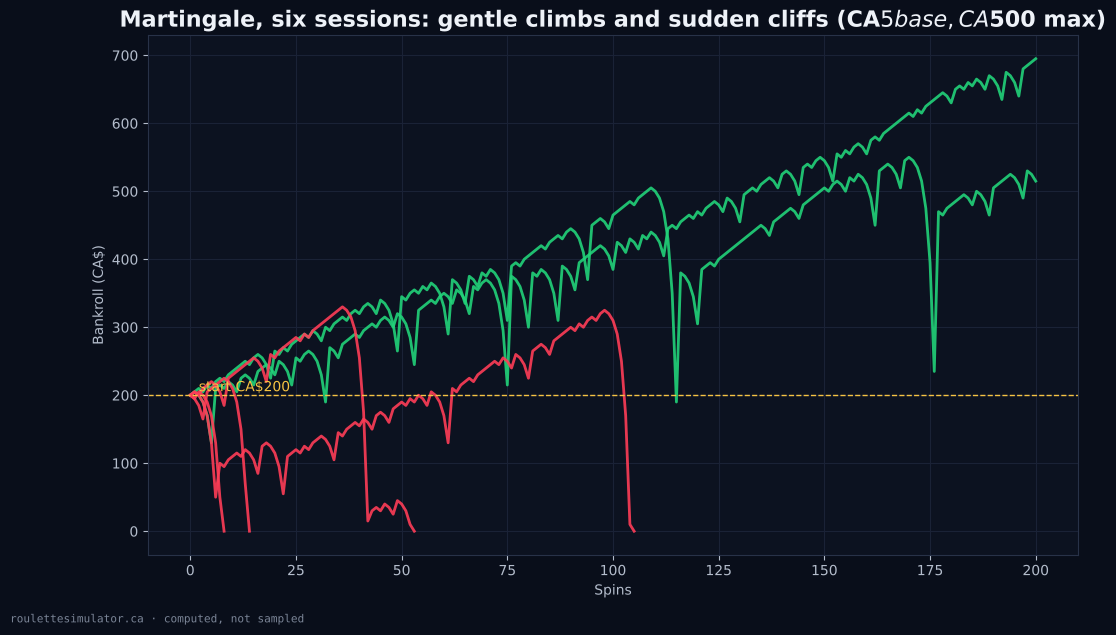
Expected value tells you the average; variance tells you how far a session wanders from it. For an even-money bet the standard deviation per spin is almost the full stake — about 0.999 × bet. For a straight-up bet it is about 5.8 × bet. Over 100 spins at CA$10, the expected loss is CA$27 either way, but the typical range (one standard deviation) is ±CA$100 on red and ±CA$580 on a single number. This is why inside-bet players remember the night they won CA$2,000 and forget the twenty nights they lost CA$300. The bankroll calculator turns variance into a bust probability for your own numbers.
Running the numbers yourself
Three habits keep roulette arithmetic honest. Count pockets, not numbers: zero is a pocket. Price bets by expected value, not by payout. And convert percentages to dollars per hour: 2.70% × CA$10 × 60 spins is CA$16.20 an hour on an RNG table. That last number is the only one that matters when deciding whether an evening's play is worth its price.